
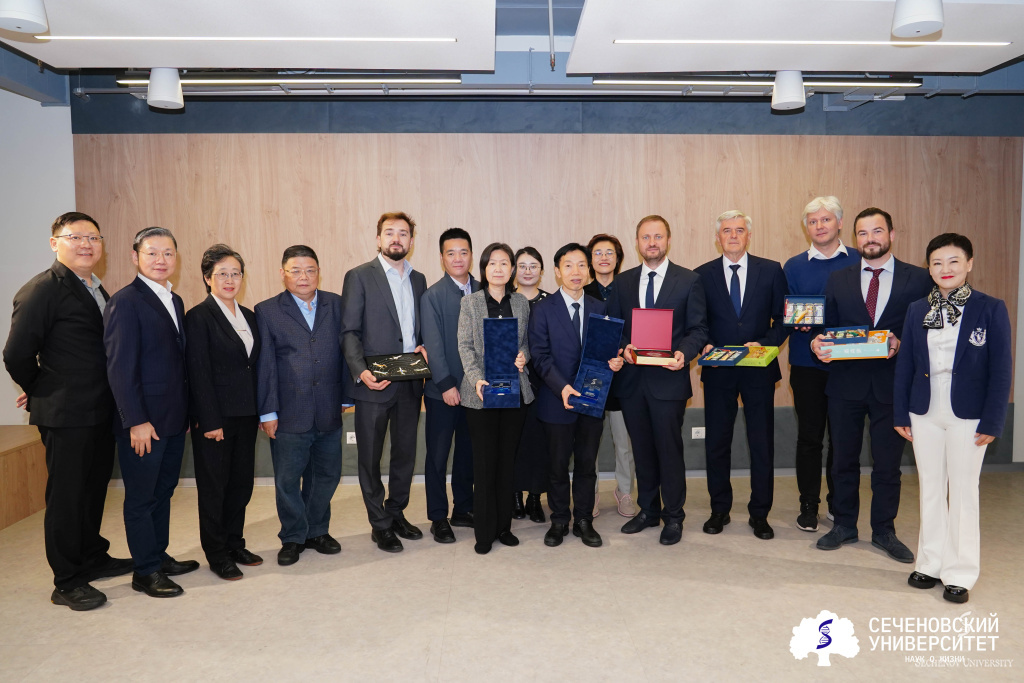
Sechenov University welcomed delegations from two prominent Chinese academic and medical centres: the Eye & ENT Hospital of Fudan University, one of China’s oldest and most prestigious universities, and Shanghai Yueyang Hospital of Integrated Traditional Chinese and Western Medicine (affiliated with Shanghai University of Traditional Chinese Medicine).
The guests toured the Biomedical Science and Technology Park and observed advanced diagnostic and treatment methods at the Kozhevnikov Clinic of Nervous Diseases. The business programme began with a meeting where participants identified key areas of mutual interest — combining rich academic traditions with innovative technologies — and shared achievements in modern medicine.
Special emphasis was placed on long-term partnership. Mark Taratkin, Head of the Office of Academic Cooperation at Sechenov University, noted that the Sino-Russian Association of Medical Universities (ASRMU) was established in 2014 on the initiative of Sechenov University and Harbin Medical University and now unites over 100 universities from both countries.
“Today we have more than 25 agreements with Chinese partners. Every year, several grants and dozens of joint research projects are launched at Sechenov University. We currently have around 5,000 international students, including 700 from China. On 29 September, we will visit Shanghai for an RCAMU meeting with over 50 universities. We have also sent invitations for the Eurasian Association of Life Sciences Universities meeting in October,” Taratkin said.
Professor Xintao Zhou, President of the Eye & ENT Hospital of Fudan University, said: “It is a great honour to present Fudan University with my team. Our university was founded in 1952, and over nearly 70 years we have built a large campus focused, like Sechenov University, on teaching students from around the world. We would very much like to demonstrate our capabilities in laser technologies, especially laser surgery, to Russian doctors and students.”
Professor Min Zhang, speaking on behalf of Shanghai University of Traditional Chinese Medicine and Yueyang Hospital, said: “Our profile reflects the integration of Chinese and Western medicine. We combine traditional methods with modern technologies and the latest scientific advances to achieve the best results for patients. This is our deep point of connection with Sechenov University, which also builds on its traditions to create cutting-edge treatments. We hope for strong and mutually beneficial cooperation.”
During the nearly two-hour tour of the Biomedical Science and Technology Park, Anastasia Nesterova, Deputy Director for Academic and Educational Work at the Institute of Regenerative Medicine, presented the latest developments and research. Chinese colleagues showed particular interest in the molecular laboratory, where they discussed macrophage research and its role in inflammation and tissue repair. They also viewed electrospinning equipment, a Russian-developed 3D bioprinter, and samples of artificial skin.
At the University Clinical Hospital No. 3, Chinese specialists in traditional medicine, pain management, and trauma rehabilitation observed modern rehabilitation methods for patients with motor disorders and brain injuries. Dmitry Druzhinin, Deputy Chief Physician for Science and Innovation, personally guided the guests through the departments, where they observed a therapeutic exercise session and tried an EEG helmet for high-precision brain diagnostics and a rhythmic transcranial magnetic stimulation device.
“We are always happy to train Chinese colleagues at our clinic,” Dr. Druzhinin said. “And we will eagerly learn from your unique experience in traditional medicine.”
Following the visit, the parties agreed to continue active cooperation, expand academic exchange programmes, and pursue joint research.
Sechenov University welcomed delegations from two prominent Chinese academic and medical centres: the Eye & ENT Hospital of Fudan University, one of China’s oldest and most prestigious universities, and Shanghai Yueyang Hospital of Integrated Traditional Chinese and Western Medicine (affiliated with Shanghai University of Traditional Chinese Medicine).
The guests toured the Biomedical Science and Technology Park and observed advanced diagnostic and treatment methods at the Kozhevnikov Clinic of Nervous Diseases. The business programme began with a meeting where participants identified key areas of mutual interest — combining rich academic traditions with innovative technologies — and shared achievements in modern medicine.
Special emphasis was placed on long-term partnership. Mark Taratkin, Head of the Office of Academic Cooperation at Sechenov University, noted that the Sino-Russian Association of Medical Universities (ASRMU) was established in 2014 on the initiative of Sechenov University and Harbin Medical University and now unites over 100 universities from both countries.
“Today we have more than 25 agreements with Chinese partners. Every year, several grants and dozens of joint research projects are launched at Sechenov University. We currently have around 5,000 international students, including 700 from China. On 29 September, we will visit Shanghai for an RCAMU meeting with over 50 universities. We have also sent invitations for the Eurasian Association of Life Sciences Universities meeting in October,” Taratkin said.
Professor Xintao Zhou, President of the Eye & ENT Hospital of Fudan University, said: “It is a great honour to present Fudan University with my team. Our university was founded in 1952, and over nearly 70 years we have built a large campus focused, like Sechenov University, on teaching students from around the world. We would very much like to demonstrate our capabilities in laser technologies, especially laser surgery, to Russian doctors and students.”
Professor Min Zhang, speaking on behalf of Shanghai University of Traditional Chinese Medicine and Yueyang Hospital, said: “Our profile reflects the integration of Chinese and Western medicine. We combine traditional methods with modern technologies and the latest scientific advances to achieve the best results for patients. This is our deep point of connection with Sechenov University, which also builds on its traditions to create cutting-edge treatments. We hope for strong and mutually beneficial cooperation.”
During the nearly two-hour tour of the Biomedical Science and Technology Park, Anastasia Nesterova, Deputy Director for Academic and Educational Work at the Institute of Regenerative Medicine, presented the latest developments and research. Chinese colleagues showed particular interest in the molecular laboratory, where they discussed macrophage research and its role in inflammation and tissue repair. They also viewed electrospinning equipment, a Russian-developed 3D bioprinter, and samples of artificial skin.
At the University Clinical Hospital No. 3, Chinese specialists in traditional medicine, pain management, and trauma rehabilitation observed modern rehabilitation methods for patients with motor disorders and brain injuries. Dmitry Druzhinin, Deputy Chief Physician for Science and Innovation, personally guided the guests through the departments, where they observed a therapeutic exercise session and tried an EEG helmet for high-precision brain diagnostics and a rhythmic transcranial magnetic stimulation device.
“We are always happy to train Chinese colleagues at our clinic,” Dr. Druzhinin said. “And we will eagerly learn from your unique experience in traditional medicine.”
Following the visit, the parties agreed to continue active cooperation, expand academic exchange programmes, and pursue joint research.