

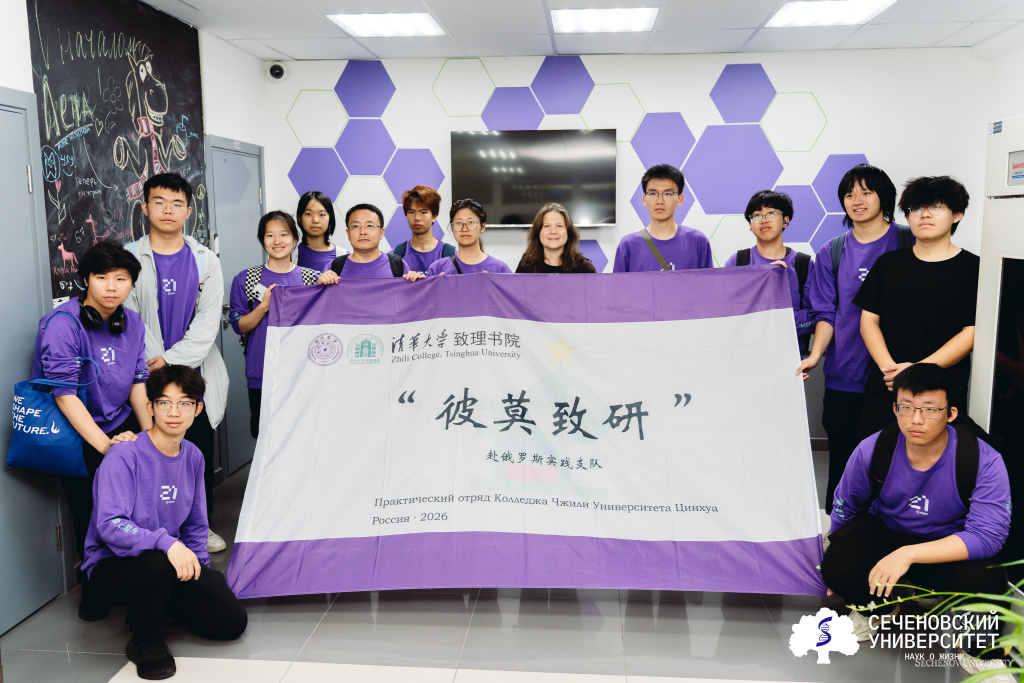
Fourteen students from Zhili College at Tsinghua University visited Russia at the invitation of Sber’s School 21 to take part in an intensive programme on artificial intelligence and interdisciplinary research, with a special focus on medicine and biotechnology. The programme included visits to leading medical universities and research centres in Moscow and St Petersburg.
At the digital campus School 21. Sechenov, the Chinese students joined a prompt engineering masterclass and an interactive project management game. They created web pages for student sports communities, research groups, and cultural exchange apps.
“We are glad that our educational solutions are in international demand,” said Yuri Ognev, Director of the School 21. Sechenov digital campus. “Through peer-to-peer learning, Tsinghua students explored prompt engineering, cloud services, and learned how modern technology, medicine, and research are integrated at Sechenov University’s Biomedical Science and Technology Park. Such meetings help bring together different cultures, scientific schools, and professional communities, creating a basis for future cooperation in medicine and technology.”
For first-year Zhili College students, much of the experience was new. “We were fascinated by the peer-to-peer education model,” said Zhentao Wang. “At our university, teachers usually control everything, so this was a completely new experience. I was also surprised that Sechenov students take part in research from their first years, and that there is strong trust between teachers and students.”
The visit to Sechenov University’s Biomedical Science and Technology Park made a strong impression. Anastasia Nesterova, Associate Professor and Deputy Director for Academic and Educational Work at the Institute of Regenerative Medicine, introduced the students to key research areas, including cell therapy, tissue engineering, and gene engineering. She spoke about the MSK-2 space experiment, carried out by the Institute of Regenerative Medicine for Roscosmos together with RSC Energia and TsNIIMash. Researchers are creating a bioreactor with living cells to be sent into orbit to study how microgravity affects human cells and tissues.
Students also saw Russian-developed 3D bioprinting technology, electrospinning equipment for ultra-thin fibres, and freeze-drying systems for creating porous materials for tissue engineering, including artificial skin. “I learned a lot about medical and bioengineering technologies,” said student Jie Dang. “I was most impressed by the 3D bioprinting and electrospinning equipment. It is very advanced and connected to my field — chemistry. The laboratories here are also very clean and well organised.”
At the Troyan Center Museum of the History of Medicine, students learned about the milestones of Russian medicine and the traditions of Sechenov University. During a Q&A session, Nesterova said the university’s priorities are personalised medicine, cell technologies, gene therapy, and fundamental research. Asked what students should be like in the age of AI, she stressed critical thinking. “We want our students to have the competencies to use artificial intelligence correctly. Then it will truly help — not instead of you, but together with you,” she said.
The student exchange became the first joint project under a 2026–2028 cooperation agreement between Sber and Tsinghua University. It provides for joint educational intensives with School 21, scientific conferences and research, and cooperation in AI and digital education.
Fourteen students from Zhili College at Tsinghua University visited Russia at the invitation of Sber’s School 21 to take part in an intensive programme on artificial intelligence and interdisciplinary research, with a special focus on medicine and biotechnology. The programme included visits to leading medical universities and research centres in Moscow and St Petersburg.
At the digital campus School 21. Sechenov, the Chinese students joined a prompt engineering masterclass and an interactive project management game. They created web pages for student sports communities, research groups, and cultural exchange apps.
“We are glad that our educational solutions are in international demand,” said Yuri Ognev, Director of the School 21. Sechenov digital campus. “Through peer-to-peer learning, Tsinghua students explored prompt engineering, cloud services, and learned how modern technology, medicine, and research are integrated at Sechenov University’s Biomedical Science and Technology Park. Such meetings help bring together different cultures, scientific schools, and professional communities, creating a basis for future cooperation in medicine and technology.”
For first-year Zhili College students, much of the experience was new. “We were fascinated by the peer-to-peer education model,” said Zhentao Wang. “At our university, teachers usually control everything, so this was a completely new experience. I was also surprised that Sechenov students take part in research from their first years, and that there is strong trust between teachers and students.”
The visit to Sechenov University’s Biomedical Science and Technology Park made a strong impression. Anastasia Nesterova, Associate Professor and Deputy Director for Academic and Educational Work at the Institute of Regenerative Medicine, introduced the students to key research areas, including cell therapy, tissue engineering, and gene engineering. She spoke about the MSK-2 space experiment, carried out by the Institute of Regenerative Medicine for Roscosmos together with RSC Energia and TsNIIMash. Researchers are creating a bioreactor with living cells to be sent into orbit to study how microgravity affects human cells and tissues.
Students also saw Russian-developed 3D bioprinting technology, electrospinning equipment for ultra-thin fibres, and freeze-drying systems for creating porous materials for tissue engineering, including artificial skin. “I learned a lot about medical and bioengineering technologies,” said student Jie Dang. “I was most impressed by the 3D bioprinting and electrospinning equipment. It is very advanced and connected to my field — chemistry. The laboratories here are also very clean and well organised.”
At the Troyan Center Museum of the History of Medicine, students learned about the milestones of Russian medicine and the traditions of Sechenov University. During a Q&A session, Nesterova said the university’s priorities are personalised medicine, cell technologies, gene therapy, and fundamental research. Asked what students should be like in the age of AI, she stressed critical thinking. “We want our students to have the competencies to use artificial intelligence correctly. Then it will truly help — not instead of you, but together with you,” she said.
The student exchange became the first joint project under a 2026–2028 cooperation agreement between Sber and Tsinghua University. It provides for joint educational intensives with School 21, scientific conferences and research, and cooperation in AI and digital education.