


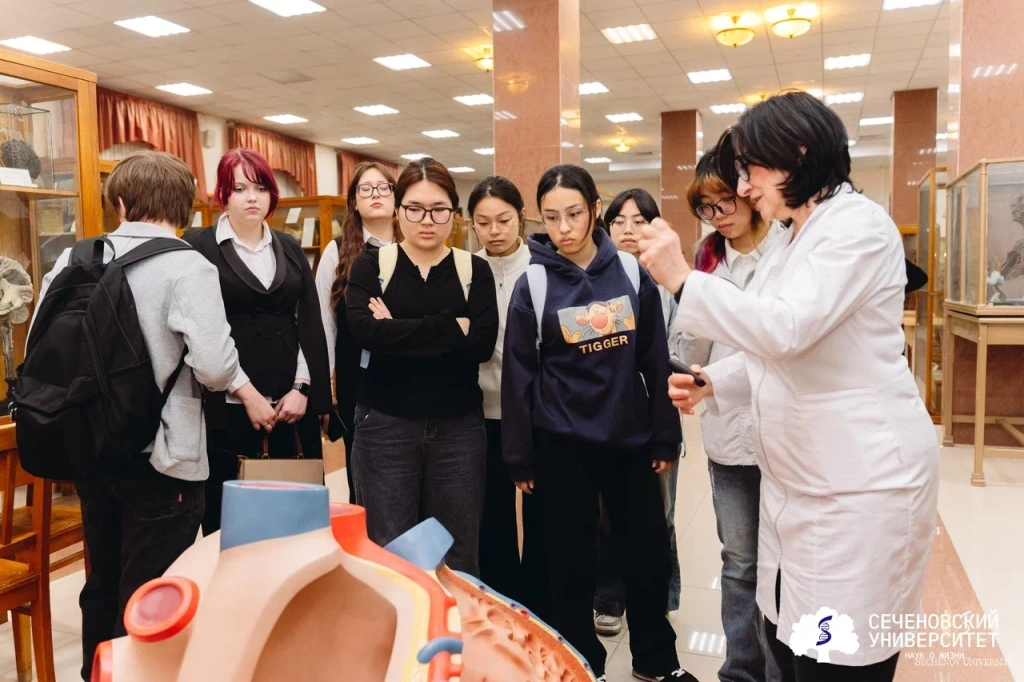
“A new universe” and “an amazing experience” — that’s how Chinese students described their visit to the Human Anatomy Museum at Sechenov University. Two exhibition halls featuring anatomical specimens from all branches of medicine opened their doors to the guests. Skeletons, skulls, organs, organ systems, and X‑ray images offer a complete picture of the human body’s structure — a unique collection carefully preserved at the Department of Human Anatomy and Histology.
The students, who come from Chengdu University of Traditional Chinese Medicine, are doing an internship in Biotechnology at Sechenov’s Institute of Pharmacy.
“In today’s fast‑moving world of science, an international internship is no longer just a CV booster. For a student, it’s a real reset — a chance to go beyond the familiar and discover new horizons in science. It broadens professional outlook, develops flexible thinking, and encourages bold experimentation with new approaches,” says Maria Anurova, internship supervisor and professor at the Department of Pharmaceutical Technology.
During their internship, the students explore Sechenov University’s rich history, cutting‑edge research, scientific achievements, and educational process. The Human Anatomy Museum is a must‑see — it represents the essence of Russia’s academic approach to teaching anatomy and houses a reference collection of specimens.
The curriculum at Chengdu University includes both human anatomy and traditional Chinese medicine. According to student Shao Chunyang, she has never seen an anatomy museum with such historically valuable and diverse exhibits. “Here you can study every aspect of the human body’s structure — all the major systems: cardiovascular, respiratory, nervous, genitourinary, and the musculoskeletal system,” she shares.
In their first semester, Chinese students study human anatomy with a focus on body structure, organ systems, and their interaction from the perspective of traditional Chinese medicine. “Today’s visit to the anatomy museum made abstract knowledge vivid and real, allowing me to truly appreciate the complexity and harmony of the human body. It bridged the gap between theoretical learning and practical observation and strengthened my dedication to study with the commitment and attention to detail that medicine demands,” the future biotechnologist adds.
According to Maria Anurova, in medical biotechnology an international internship acts as a catalyst for professional, scientific, and career growth. The field is advancing rapidly — new methods, technologies, and discoveries emerge constantly. Internships let students learn about cutting‑edge developments and current trends directly, not just from textbooks and articles.
A key component of international exchange is immersion in a unique multicultural environment. “The Human Anatomy Museum at Sechenov University is not just a collection of specimens — it conveys the university’s history and scientific legacy. The tour drew enthusiastic responses from the Chinese students and helped them understand how human anatomy is taught in Russia. Such knowledge will be valuable to them in the future, when global science opens its doors wide,” emphasizes Tatyana Zharikova, Associate Professor at the Department of Human Anatomy and Histology.
“A new universe” and “an amazing experience” — that’s how Chinese students described their visit to the Human Anatomy Museum at Sechenov University. Two exhibition halls featuring anatomical specimens from all branches of medicine opened their doors to the guests. Skeletons, skulls, organs, organ systems, and X‑ray images offer a complete picture of the human body’s structure — a unique collection carefully preserved at the Department of Human Anatomy and Histology.
The students, who come from Chengdu University of Traditional Chinese Medicine, are doing an internship in Biotechnology at Sechenov’s Institute of Pharmacy.
“In today’s fast‑moving world of science, an international internship is no longer just a CV booster. For a student, it’s a real reset — a chance to go beyond the familiar and discover new horizons in science. It broadens professional outlook, develops flexible thinking, and encourages bold experimentation with new approaches,” says Maria Anurova, internship supervisor and professor at the Department of Pharmaceutical Technology.
During their internship, the students explore Sechenov University’s rich history, cutting‑edge research, scientific achievements, and educational process. The Human Anatomy Museum is a must‑see — it represents the essence of Russia’s academic approach to teaching anatomy and houses a reference collection of specimens.
The curriculum at Chengdu University includes both human anatomy and traditional Chinese medicine. According to student Shao Chunyang, she has never seen an anatomy museum with such historically valuable and diverse exhibits. “Here you can study every aspect of the human body’s structure — all the major systems: cardiovascular, respiratory, nervous, genitourinary, and the musculoskeletal system,” she shares.
In their first semester, Chinese students study human anatomy with a focus on body structure, organ systems, and their interaction from the perspective of traditional Chinese medicine. “Today’s visit to the anatomy museum made abstract knowledge vivid and real, allowing me to truly appreciate the complexity and harmony of the human body. It bridged the gap between theoretical learning and practical observation and strengthened my dedication to study with the commitment and attention to detail that medicine demands,” the future biotechnologist adds.
According to Maria Anurova, in medical biotechnology an international internship acts as a catalyst for professional, scientific, and career growth. The field is advancing rapidly — new methods, technologies, and discoveries emerge constantly. Internships let students learn about cutting‑edge developments and current trends directly, not just from textbooks and articles.
A key component of international exchange is immersion in a unique multicultural environment. “The Human Anatomy Museum at Sechenov University is not just a collection of specimens — it conveys the university’s history and scientific legacy. The tour drew enthusiastic responses from the Chinese students and helped them understand how human anatomy is taught in Russia. Such knowledge will be valuable to them in the future, when global science opens its doors wide,” emphasizes Tatyana Zharikova, Associate Professor at the Department of Human Anatomy and Histology.