
Sechenov University urologists present MILES study results at London congress
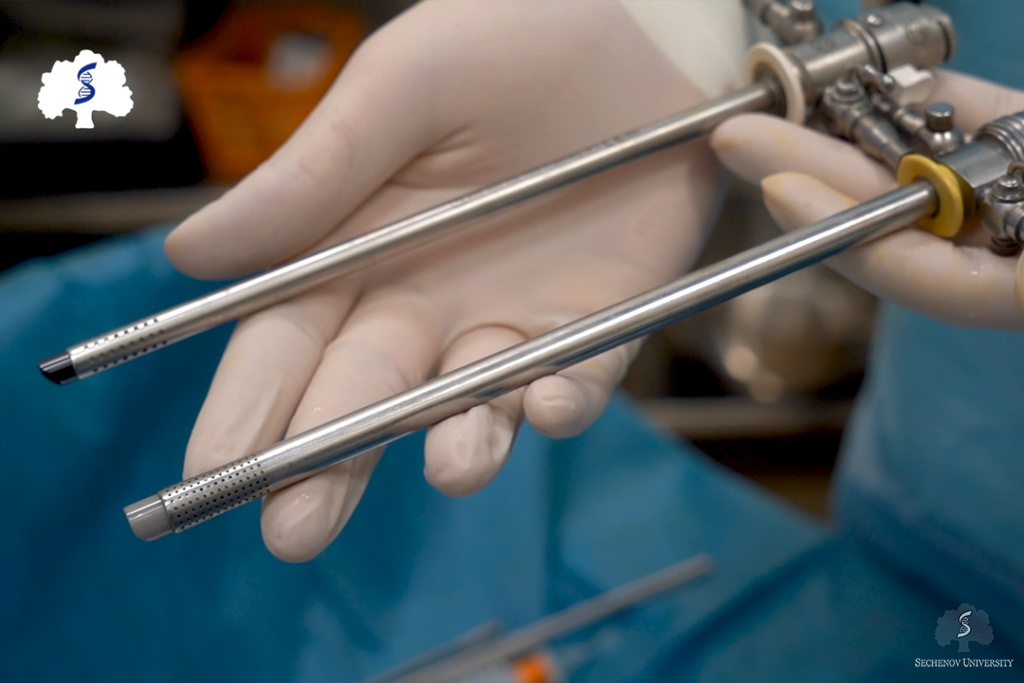
For the first time in global clinical practice, urologists at Sechenov University have conducted a randomized trial comparing minimally invasive laser enucleation of prostatic hyperplasia (MiLEP) with standard endoscopic enucleation using a thulium fiber laser. The study results were presented at EAU26 — the Congress of the European Association of Urology.
The podium presentation by the expert group from the Institute of Urology and Human Reproductive Health was included in the official program of EAU26 in London. "The MILES study: A prospective randomized trial of the safety and efficacy of minimally invasive laser enucleation of the prostate versus standard laser enucleation" is the first work to compare minimally invasive laser enucleation of prostatic hyperplasia (MiLEP) with standard endoscopic enucleation using a thulium fiber laser.
"Preliminary study results showed comparable functional outcomes in the MiLEP and standard technique groups at one and three months of follow-up — in terms of urinary flow rate and post-void residual volume. However, the rate of stress urinary incontinence immediately after catheter removal was significantly lower in the MiLEP group — 6.5% versus 29.5%. In addition, urethral strictures occurred less frequently in the MiLEP group — 1.3% versus 6.4%," said Vladislav Petov, researcher at the Institute of Urology and Human Reproductive Health, Sechenov University. According to the speaker, these data suggest that instrument miniaturization in benign prostatic hyperplasia surgery can reduce trauma to the urethra and sphincter mechanism without compromising the effectiveness of the intervention.
Leading figures in world urology took an interest in the Moscow colleagues' report and shared their views on the MiLEP technique. Fernando Gómez Sancha, Head of the Urology and Robotic Surgery Department at ICUA–Clínica CEMTRO (Madrid, Spain), said: "The data presented at EAU26 confirm the clinical benefits of miniaturization. Using a 22Ch instrument compared to the standard 26Ch reduces the rate of early stress urinary incontinence." One of the most authoritative international experts in prostate enucleation emphasized that the MILES study provides important randomized evidence that MiLEP offers comparable efficacy with potentially less trauma to the urethra and sphincter mechanism.
Cosimo De Nunzio, Professor at Sapienza University (Rome, Italy), called the MILES results the most significant report of EAU26 and highlighted the study's contribution to advancing the concept of instrument miniaturization in urology. "Thus, it has been confirmed that MiLEP is regarded by the international expert community as a logical evolutionary development of standard laser enucleation," he wrote on his channel.
MiLEP was introduced into clinical practice at the Institute of Urology and Human Reproductive Health in 2023. By the end of 2025, 300 MiLEP procedures had been performed — the largest Russian experience with this technology. "The MILES study is perceived by the global urological community not only as a scientific research outcome but also as significant practical experience advancing minimally invasive laser enucleation of prostatic hyperplasia. The Institute of Urology at Sechenov University is already emerging as a center of expertise that sets the direction for the further development of MiLEP in Russia and abroad," noted Mikhail Enikeev, Head of Urology Department No. 2 at the Sechenov University Urology Clinic.