Tech leadership in medicine: key discussions at Sechenov University Forum
The International Medical Forum "University Science. Innovations 2026" has opened at Sechenov University. This year’s event is dedicated to the role of academic science in implementing Russia’s Healthcare Development Strategy through 2030 and achieving technological sovereignty in medicine.
Participants included representatives from the Ministries of Health, Education and Science, Industry and Trade, the Russian Science Foundation, industry partners, and medical and technical universities.
In a video address, Mikhail Murashko, Russian Health Minister, noted that the healthcare system is shifting "from the paradigm of long life to the paradigm of healthspan," with university science playing a key role.
Vadim Tarasov, Vice-Rector for Scientific and Technological Development at Sechenov University, moderated the plenary session. He highlighted that medical universities must not only conduct research but also create an environment for collaboration with industry and the development of young researchers.
Mikhail Samsonov, Medical Director of R-Pharm, shared that a multidisciplinary team at Sechenov University proposed a new research direction for an orphan disease drug, a model later scaled to other projects.
Irina Panarina, CEO of AstraZeneca Russia & Eurasia, argued that universities are no longer just talent suppliers but part of the innovation ecosystem — where simulation labs, translational approaches, and professional environments for collaboration are built.
Key speakers included:
-
Tatiana Semenova, Deputy Health Minister, spoke about regulatory mechanisms for personalized therapies, noting that since 2024, four individual biomedical cell products are already available to patients.
-
Ekaterina Priezzheva, Deputy Industry and Trade Minister, emphasized seamless transition from fundamental research to industrial production, citing the first Russian hemodialysis machine developed by Sechenov University and Rosatom.
-
Elena Popova (Russian Science Foundation) and Irina Zhukova (Gazprombank Center for Technological Leadership) discussed funding mechanisms for university-driven tech projects.
The forum also featured an exhibition of R&D projects:
-
Sechenov’s Engineering Center showcased biocompatible medical devices: biopsy tools, trocars for intracavitary surgery, jaw implants, spinal cages, and bioresorbable screws.
-
The Advanced Engineering School and Institute of Bionic Technologies presented a brain–computer interface, retinal implant, thin-film nerve cuff, and tissue-equivalent phantoms for surgical training.
-
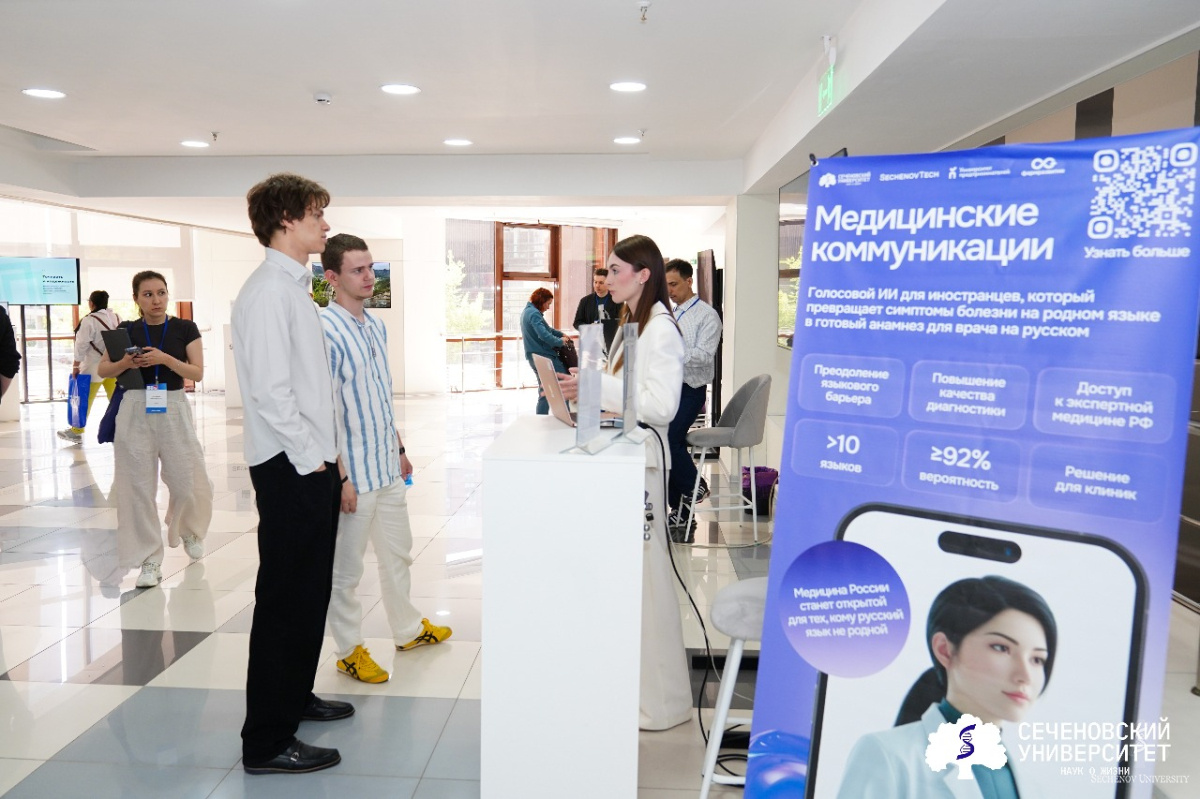
SechenovTech accelerator projects included a robotic system for early colorectal cancer detection, an AI voice assistant for foreign patients, and digital services for breast cancer patients and pregnancy support.
The forum included an awards ceremony for universities participating in the "University Science Relay Race 2026." Forty universities presented 284 projects in medical and biomedical technologies.