
Oncoproctologists at Sechenov University are the first in Russia to study the efficacy of extended lymph node dissection in colon cancer
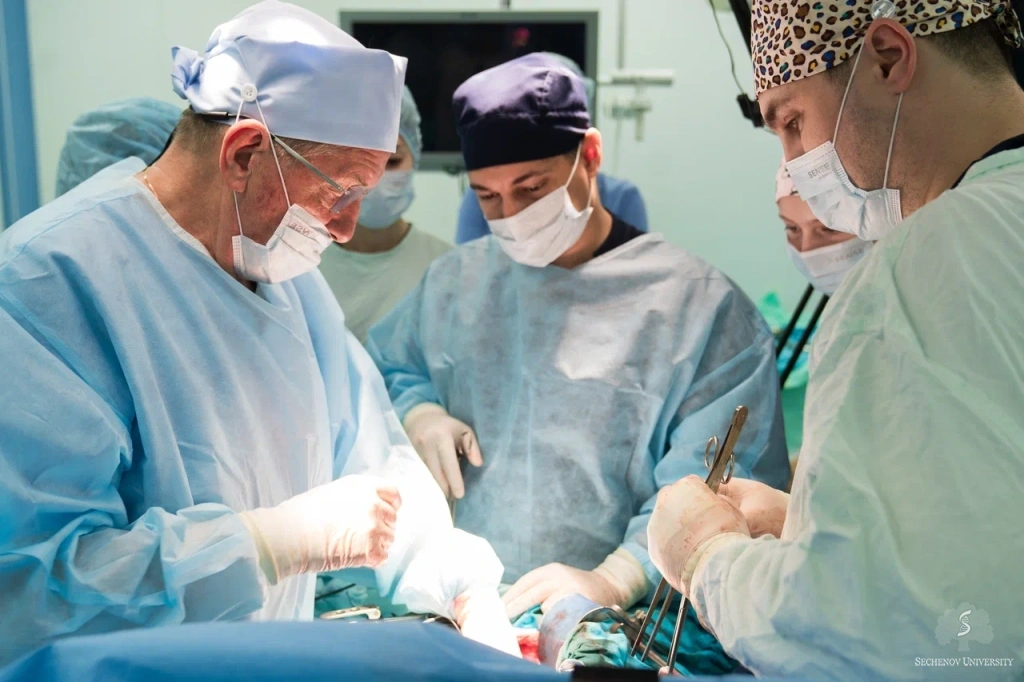
The Clinic of Coloproctology and Minimally Invasive Surgery at Sechenov University is conducting a unique study, DILEMMA, and is also participating in the multicenter RICON trial. These studies are dedicated to evaluating the standard D2 lymph node dissection approach versus the extended D3 lymph node dissection in patients with colon cancer. Based on the results, surgeons will be able to compare the survival rates of patients with stage II and stage III cancer following D2 or D3 lymphadenectomy.
In coloproctology, lymph node dissection is performed to determine the stage of the oncological disease. Cancer cells can spread from the primary tumor to the lymph nodes. If cancer cells are present in the lymph nodes, it indicates a more advanced stage of the disease. Furthermore, removing the lymph nodes helps reduce the likelihood of further cancer spread throughout the body and improves the patient's chances of recovery.
The multicenter RICON trial began in 2017, and the Clinic of Coloproctology and Minimally Invasive Surgery (CCMIS) joined in 2020. It compares the standard approach of D2 right hemicolectomy (removal of the right side of the colon along with lymph nodes) with extended D3 lymph node dissection. Extended lymphadenectomy involves removing the maximum possible number of lymph nodes, including distant ones where metastases might be located. The Director of CCMIS, Petr Tsarkov, is a pioneer in performing D3 lymph node dissection in Russia. It was he who, over 15 years ago, adapted this Japanese technique for treating patients of European build.
"Extended lymph node dissection is a complex surgical technique. For quite a long time, the community of oncoproctologists avoided using it, adhering to the opinion that it was unsafe for patients. But if you know how to work correctly with blood vessels, then it is safe surgery, including from the standpoint of oncological radicalism," shares Petr Tsarkov.
According to data from the RICON trial for 2021, the five-year survival rate for patients with stage III right-sided colon cancer after extended lymph node dissection is 85.4%, compared to 70.7% after D2 dissection. Clinicians are awaiting the long-term results of the study.
"Despite these being interim results, such figures cannot be ignored. It's not always possible to distinguish stage II from stage III on CT scans, which is why at the Clinic of Coloproctology of Sechenov University, we perform extended lymph node dissection for both stage II and stage III. The long-term results of the study will allow us to initiate the inclusion of this approach in clinical guidelines," clarifies Vladimir Balaban, Professor at the Department of Surgery, Institute of Clinical Medicine, Sechenov University.
The DILEMMA study is dedicated to comparing D2 and D3 lymph node dissection in patients with stage III left-sided colon cancer. Currently, this is the only study of its kind in the world. Alongside CCMIS, 15 clinics are participating, with plans for international expert centers to join. The long-term results of the study are expected in 2028.
"I hope that the RICON and DILEMMA studies will prove the feasibility of extended lymphadenectomy for both right-sided and left-sided colon cancer. Hundreds of thousands of patients with stage III cancer will have a chance to live significantly longer – this will mark a new milestone in the development of oncoproctology in Russia and the world," emphasizes Petr Tsarkov.